



Amplitude model with sympy#
This section is a follow-up of the previous chapter, Reaction and Models, to formulate the amplitude model for the \(\gamma p \to \eta\pi^0 p\) channel example symbolically. See TR‑033 for a purely numerical tutorial.
The model we want to implement is
where \(1=\eta\), \(2=\pi^0\), and \(3=p\).
Model implementation#
l_max = 2
\(A^{12}\)#
s12, m_a2, gamma_a2, l12 = sp.symbols(r"s_{12} m_{a_2} \Gamma_{a_2} l_{12}")
theta1, phi1 = sp.symbols("theta_1 phi_1")
a = sp.IndexedBase("a")
m = sp.symbols("m", cls=sp.Idx)
A12 = sp.Sum(a[m] * sp.Ynm(l12, m, theta1, phi1), (m, -l12, l12)) / (
    s12 - m_a2**2 + sp.I * m_a2 * gamma_a2
)
A12
\(A^{23}\)#
s23, m_delta, gamma_delta, l23 = sp.symbols(
    r"s_{23} m_{\Delta^+} \Gamma_{\Delta^+} l_{23}"
)
b = sp.IndexedBase("b")
m = sp.symbols("m", cls=sp.Idx)
theta2, phi2 = sp.symbols("theta_2 phi_2")
A23 = sp.Sum(b[m] * sp.Ynm(l23, m, theta2, phi2), (m, -l23, l23)) / (
    s23 - m_delta**2 + sp.I * m_delta * gamma_delta
)
A23
\(A^{31}\)#
c = sp.IndexedBase("c")
s31, m_nstar, gamma_nstar = sp.symbols(r"s_{31} m_{N^*} \Gamma_{N^*}")
theta3, phi3, l31 = sp.symbols("theta_3 phi_3 l_{31}")
A31 = sp.Sum(c[m] * sp.Ynm(l31, m, theta3, phi3), (m, -l31, l31)) / (
    s31 - m_nstar**2 + sp.I * m_nstar * gamma_nstar
)
A31
\(I = |A|^2 = |A^{12}+A^{23}+A^{31}|^2\)#
intensity_expr = sp.Abs(A12 + A23 + A31) ** 2
intensity_expr
Phase Space Generation#
Mass for \(p\gamma\) system
E_lab_gamma = 8.5
m_proton = 0.938
m_0 = np.sqrt(2 * E_lab_gamma * m_proton + m_proton**2)
m_eta = 0.548
m_pi = 0.135
m_0
np.float64(4.101931740046389)
rng = TFUniformRealNumberGenerator(seed=0)
phsp_generator = TFPhaseSpaceGenerator(
    initial_state_mass=m_0,
    final_state_masses={1: m_eta, 2: m_pi, 3: m_proton},
)
phsp_momenta = phsp_generator.generate(500_000, rng)
Kinematic variables#
p1 = FourMomentumSymbol("p1", shape=[])
p2 = FourMomentumSymbol("p2", shape=[])
p3 = FourMomentumSymbol("p3", shape=[])
p12 = ArraySum(p1, p2)
p23 = ArraySum(p2, p3)
p31 = ArraySum(p3, p1)

theta1_expr, phi1_expr = formulate_helicity_angles(p1, p2)
theta2_expr, phi2_expr = formulate_helicity_angles(p2, p3)
theta3_expr, phi3_expr = formulate_helicity_angles(p3, p1)

s12_expr = SquaredInvariantMass(p12)
s23_expr = SquaredInvariantMass(p23)
s31_expr = SquaredInvariantMass(p31)
helicity_transformer = SympyDataTransformer.from_sympy(
    kinematic_variables, backend="jax"
)
phsp = helicity_transformer(phsp_momenta)
list(phsp)
['theta_1',
 'theta_2',
 'theta_3',
 'phi_1',
 'phi_2',
 'phi_3',
 's_{12}',
 's_{23}',
 's_{31}']
Parameters#
Note
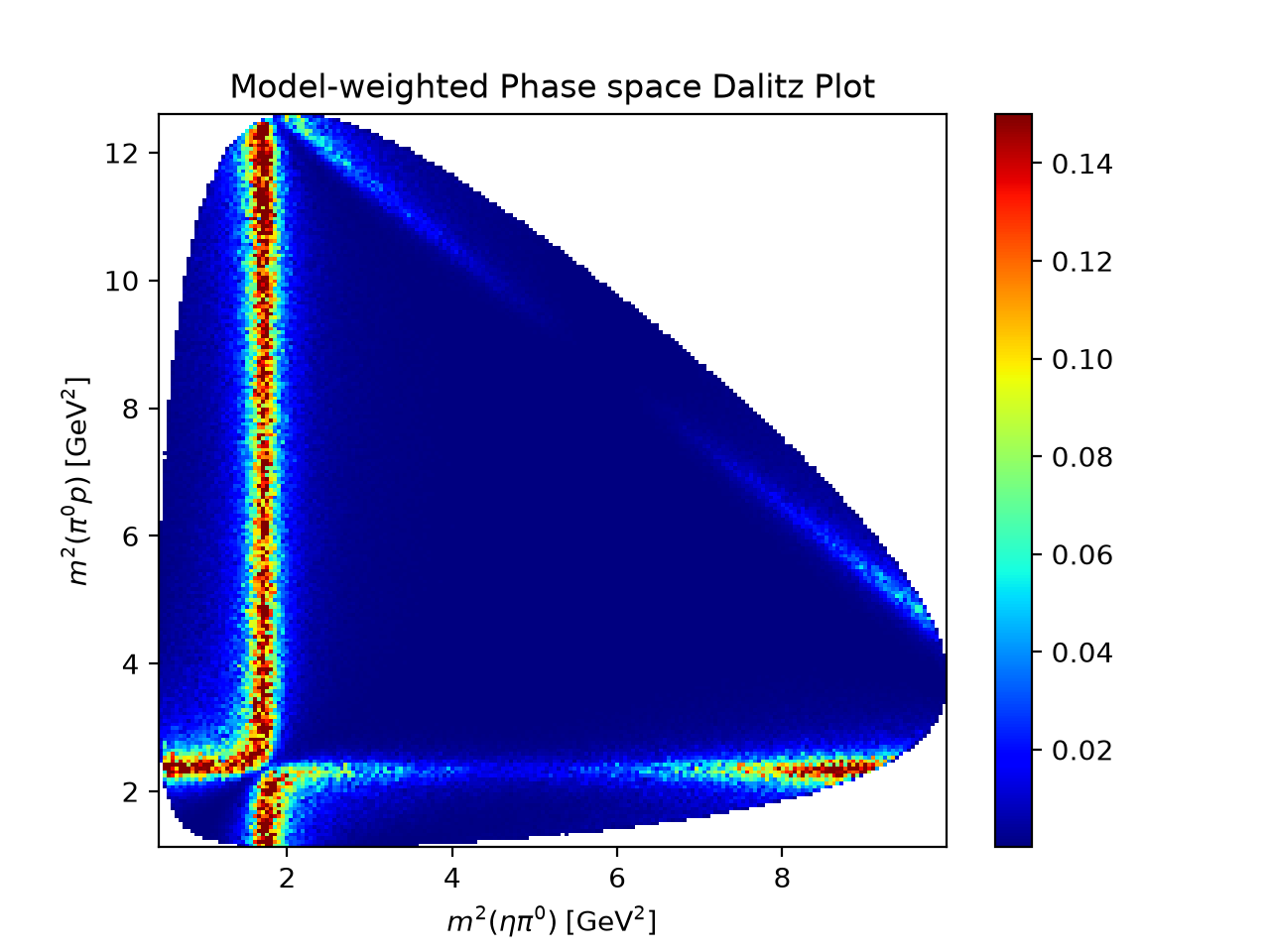
The mass and width of each resonance is customized to make the resonance bands in the Dalitz plot more visible.
Visualization#
Model components#
phi = np.pi / 4
theta = np.pi / 4
s_values = np.linspace(0, 5, num=500)
component_data = [
    {str(s): s_values, str(theta_symbol): theta, str(phi_symbol): phi}
    for s, theta_symbol, phi_symbol in [
        (s12, theta1, phi1),
        (s23, theta2, phi2),
        (s31, theta3, phi3),
    ]
]
angular_momenta = [l12_val, l23_val, l31_val]
A12_values, A23_values, A31_values = [
    funcs[l_value](data)
    for funcs, l_value, data in zip(
        amplitude_funcs, angular_momenta, component_data, strict=True
    )
]
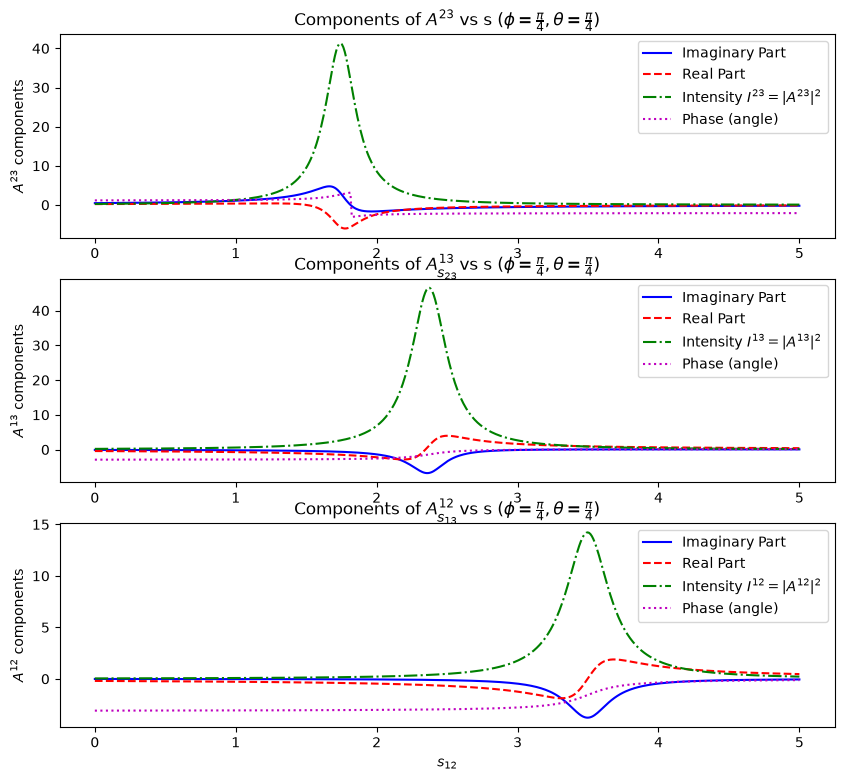
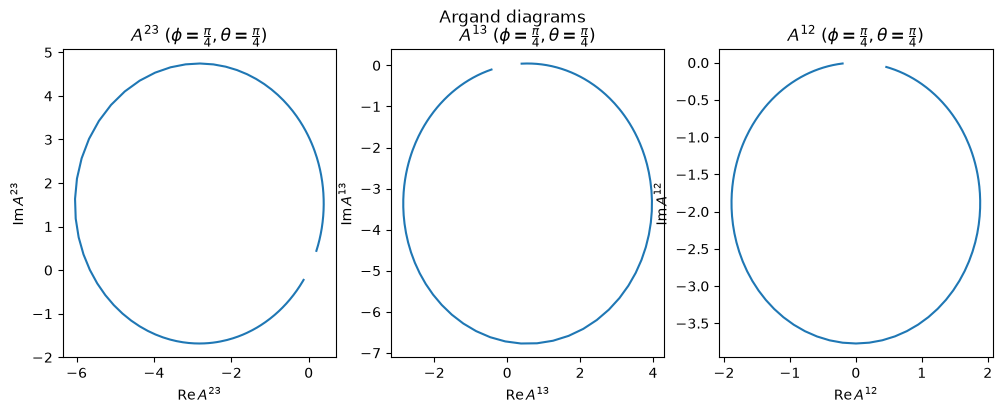
Unitarity is preserved in each of the subsystems (assuming fixed \(\phi,\theta\)), because we assume there is only one resonance in the subsystem.
Dalitz Plot#
intensity_funcs = np.array([
    [
        [
            create_parametrized_function(
                expression=intensity_expr
                .xreplace({l12: i, l23: j, l31: k})
                .doit()
                .expand(func=True),
                parameters=parameter_defaults,
                backend="jax",
            )
            for i in range(l_max + 1)
        ]
        for j in range(l_max + 1)
    ]
    for k in range(l_max + 1)
])
intensity_funcs.shape
(3, 3, 3)
%matplotlib widget
Projection#
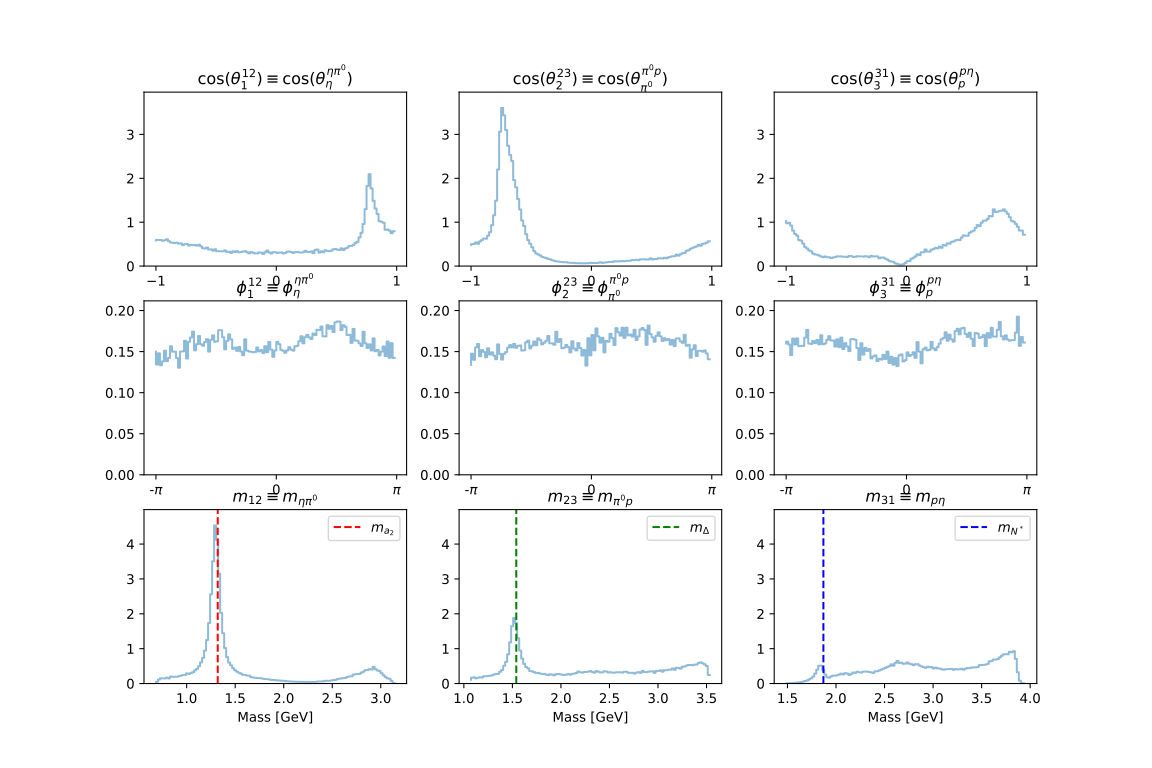
Note
The angular distributions differ from those in the original numerical tutorial because that implementation passes (phi, theta) to spherical-harmonic helper functions whose arguments are declared as (theta, phi). This interchanges the polar and azimuthal angles. Here, sympy.functions.special.spherical_harmonics.Ynm receives the angles in its documented order, \(Y_\ell^m(\theta, \phi)\).